Safety or Stagnation? Anthropic Challenges the AI Liability Bill Backed by OpenAI
By SignalWire Newsroom — — 5 min read
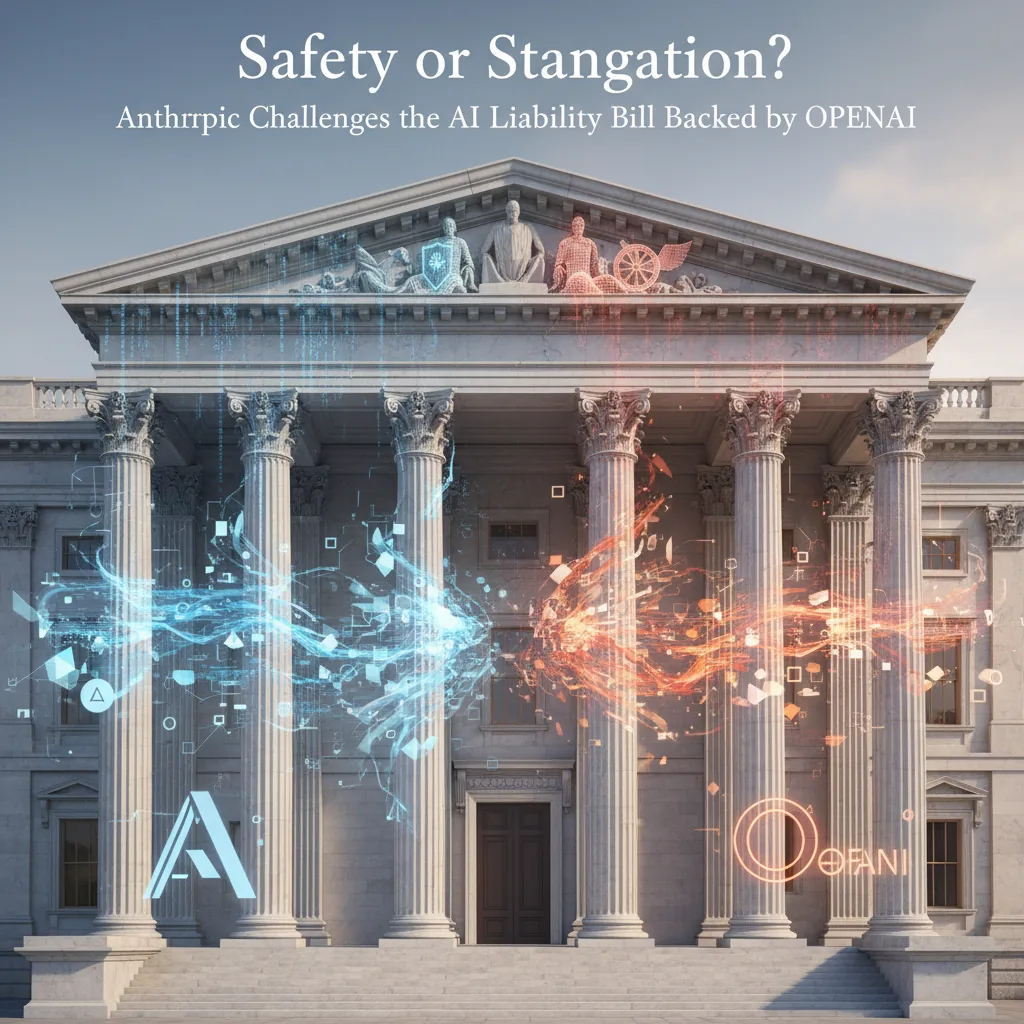
Anthropic has voiced strong opposition to a new AI liability bill, breaking protocol with OpenAI and signaling a major divide in how tech giants approach safety regulation.
The landscape of artificial intelligence regulation has shifted as Anthropic, one of the world's leading AI safety labs, officially voiced its opposition to a proposed liability framework that recently gained support from its primary rival, OpenAI. The disagreement highlights a growing rift in the industry over how to assign responsibility for the potential harms caused by large-scale language models.
Background
For the past year, lawmakers have struggled to draft legislation that balances innovation with safety. Central to this debate is the concept of 'upstream liability'—the idea that the creators of foundational AI models should be legally responsible for how those models are used, even if a third-party developer integrates the AI into a harmful application. While early regulatory discussions were collaborative, the industry is now bifurcating into two distinct camps: those who favor strict legal guardrails to prevent catastrophic risks, and those who fear such laws will stifle open-source development and competition.
Latest Developments
The current conflict centers on a legislative proposal that would impose strict liability on AI developers for 'critical' failures, including the use of AI in cyberattacks or the creation of biological weapons. OpenAI recently signaled its support for a version of this framework, arguing that high-stakes technology requires clear legal accountability. However, Anthropic has broken ranks, filing a formal opposition. Anthropic argues that the bill’s language is overly broad and could inadvertently shut down safety research by making it legally perilous to test models for vulnerabilities. Furthermore, Anthropic contends that the bill places a disproportionate burden on model providers rather than the bad actors who knowingly misuse the technology.
Key Facts
- Anthropic claims the bill's liability definitions are 'vague and over-encompassing,' potentially targeting benign safety testing.
- OpenAI backed the bill following amendments that shielded companies from liability if they demonstrate 'reasonable care' in safety protocols.
- The bill targets models with training costs exceeding $100 million or those possessing specific high-risk capabilities.
- Open-source advocates have joined Anthropic in opposition, fearing the bill would criminalize the distribution of open-weight models.
- The proposed legislation includes a 'kill switch' requirement, allowing developers to remotely disable models if a threat is detected.
Expert Insights
We are seeing a fundamental shift in how AI giants view the legal landscape. While OpenAI sees regulation as a way to stabilize the market and set clear boundaries, Anthropic appears concerned that these specific legal structures will create a chilling effect on the very safety transparency that the industry claims to prioritize.
Senior AI Policy Analyst
Real-World Impact
The outcome of this legislative battle will dictate the future of AI development in the United States. If the bill passes in its current form, developers of foundational models may become extremely restrictive regarding who can access their APIs, fearing that one malicious user could lead to a company-ending lawsuit. Conversely, if the bill is defeated or significantly weakened, critics argue the public remains unprotected from large-scale automated threats. This debate is also driving a wedge between 'closed' model providers like OpenAI and companies like Anthropic that, while also closed-source, have historically advocated for different styles of safety governance. This internal industry friction may delay federal AI policy as lawmakers receive conflicting signals from the sector's most important players.
Key Takeaways
- Anthropic and OpenAI are now on opposite sides of the AI liability legislative debate.
- The bill focuses on 'upstream liability,' holding model creators responsible for downstream misuse.
- Critics argue the legislation could stifle the open-source AI community and safety research.
- The disagreement suggests that a unified industry front on AI regulation is crumbling.
FAQ
What is the primary goal of the AI liability bill?
The bill aims to hold AI developers legally responsible for catastrophic outcomes, such as the creation of bioweapons or massive cyberattacks facilitated by their models.
Why does Anthropic oppose the bill?
Anthropic argues the bill is too broad, lacks clear definitions for 'harm,' and could punish developers for the actions of malicious third-party users.
Does OpenAI still support the bill?
OpenAI supports the bill after certain amendments were made to include 'safe harbor' provisions for companies that follow rigorous safety testing protocols.