The AI Identity Crisis: Inside the Musk and Altman Legal War Over OpenAI
By SignalWire Newsroom — — 6 min read
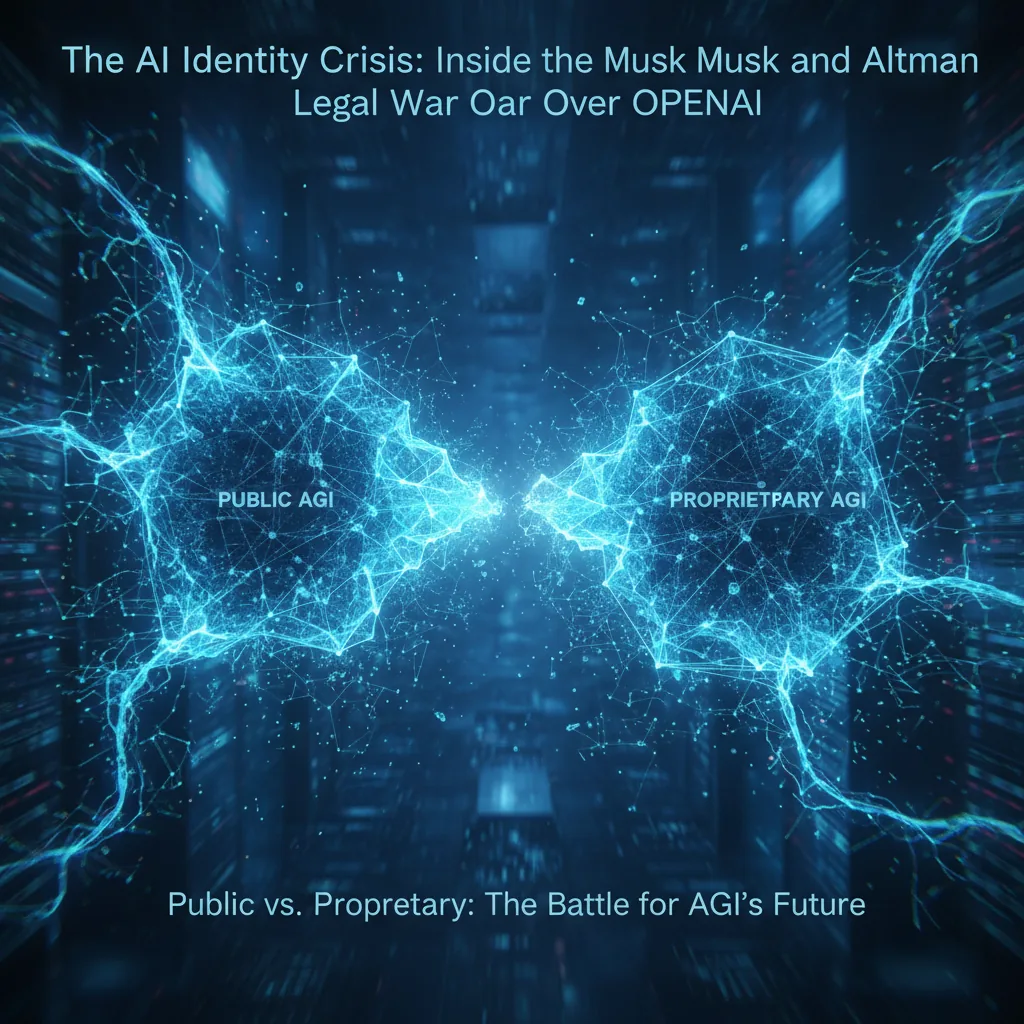
The legal clash between Elon Musk and OpenAI CEO Sam Altman highlights a growing divide over whether artificial general intelligence should be public or proprietary.
The legal confrontation between Elon Musk and OpenAI, led by CEO Sam Altman, has escalated into one of the most consequential court battles in the history of Silicon Valley. What began as a collaborative effort to ensure artificial intelligence benefited humanity has transformed into a high-stakes dispute over corporate governance, intellectual property, and the foundational mission of the world’s leading AI laboratory.
Background
In 2015, Elon Musk, Sam Altman, and Greg Brockman co-founded OpenAI as a non-profit organization. The stated goal was to develop artificial general intelligence (AGI) that was 'safe and beneficial' for all of humanity, purposefully positioning the entity as an open-source alternative to proprietary models being developed by tech giants like Google. Musk provided significant initial funding, totaling tens of millions of dollars, under the impression that the company would remain a non-profit and its research would be available to the public.
However, the relationship began to fray in 2018 when Musk unsuccessfully attempted to take control of the company. Following his departure from the board, OpenAI shifted its structure, creating a 'capped-profit' subsidiary to attract the massive capital required for compute power. This pivot led to a multi-billion dollar partnership with Microsoft, a move Musk claims violates the original 'founding agreement' of the organization.
Latest Developments
The legal battle intensified recently as Musk filed an amended lawsuit in federal court. The updated complaint alleges that OpenAI is now operating as a 'de facto subsidiary' of Microsoft. Musk’s legal team argues that by prioritizing commercial interests and keeping its most advanced models—like GPT-4—behind closed doors, OpenAI has abandoned its mission to serve humanity.
OpenAI has moved to dismiss the suit, characterizing Musk’s actions as an attempt to harass a successful competitor. The company released a series of historical emails suggesting that Musk was aware of, and even supported, the eventual transition to a for-profit structure to secure the resources necessary for AGI development. The court must now weigh the validity of an unwritten 'founding agreement' against the corporate realities of modern AI scale.
Key Facts
- Musk alleges a breach of contract regarding OpenAI’s non-profit status.
- OpenAI claims there was never a formal, signed founding agreement.
- Microsoft has invested an estimated $13 billion in the AI startup.
- The lawsuit specifically names Sam Altman and Greg Brockman as defendants.
- Discovery processes could reveal sensitive internal communications regarding AGI progress.
Expert Insights
'This case represents a fundamental tension between the idealistic roots of AI safety and the brutal capital requirements of the AI arms race. The outcome will likely define how future non-profit labs transition into commercial powerhouses without losing legal standing,' noted a Silicon Valley legal analyst.
Real-World Impact
The outcome of this litigation extends far beyond the boardroom. If the court sides with Musk, it could potentially force OpenAI to open-source its technology or restructure its relationship with Microsoft, which would send shockwaves through the global tech economy. Conversely, a victory for OpenAI would solidify the 'capped-profit' model as a viable path for mission-driven startups.
Furthermore, the trial may bring much-needed clarity to the legal definition of 'Artificial General Intelligence.' If OpenAI’s technology is legally deemed to have reached AGI, its licensing agreements with Microsoft could be triggered or terminated, depending on the specifics of their contract, which excludes AGI from commercial licensing.
Key Takeaways
- The lawsuit centers on whether OpenAI violated its original non-profit mission.
- Internal emails suggest Musk may have originally supported for-profit funding models.
- The definition of 'AGI' is a critical legal lever in the partnership with Microsoft.
- This case could set a legal precedent for transparency in AI development.
FAQ
Why is Elon Musk suing OpenAI?
Elon Musk claims OpenAI breached its founding agreement by becoming a closed-source, for-profit subsidiary of Microsoft.
What is OpenAI's defense?
OpenAI argues there was no formal contract and that Musk is acting out of competitive jealousy after his own AI efforts failed to gain similar traction.
How will this impact the AI industry?
It could lead to forced open-sourcing of models or significant changes to how AI companies structure their non-profit and for-profit arms.